There is one question every finance leader should be able to answer about their company's data — and almost none can. It is not "how much do we have," "where is it stored," or "is it in the cloud." It is this:
If I asked our systems, in plain English, "which of our customers cost us money last quarter," — could anyone here answer it without opening a spreadsheet?
If the answer is no — and it almost always is — the problem you are about to solve by buying another dashboard is not the problem you actually have.
01. The procurement trap
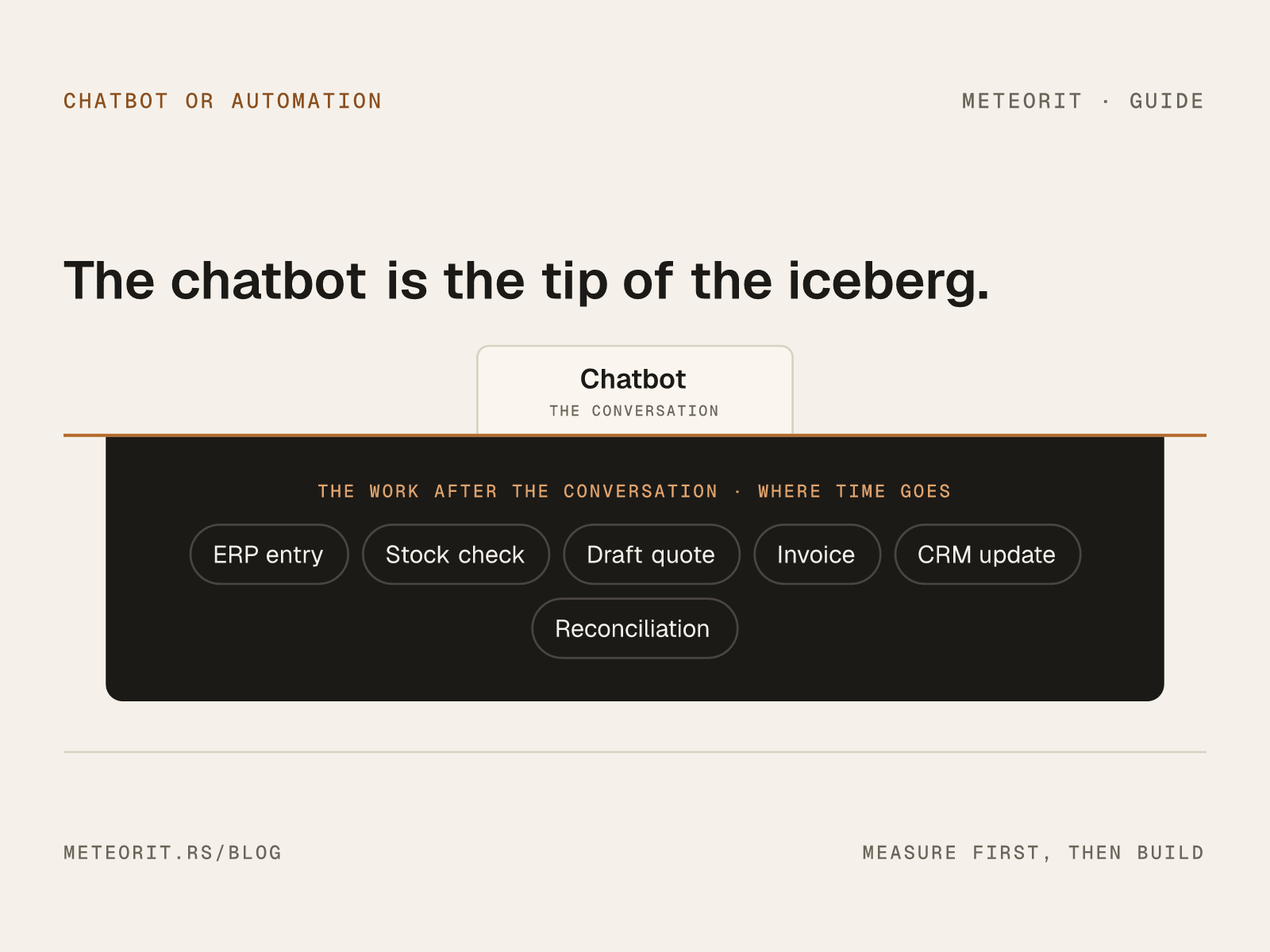
Most mid-sized firms own three to six SaaS systems that each contain a partial answer to that question. The CRM has the customers. The accounting tool has the cost. The support ticket platform has the time spent. The project tool has the deliverables. Each tool ships with a dashboard. None of them speak to each other.
So a finance leader, looking at a flat margin and a slow quarter, does the rational thing: she asks for a unified view. The answer arrives as a proposal for a seventh tool — a "BI platform" or an "analytics suite" — that promises to draw from the other six.
This rarely works, because the seventh tool inherits the same boundaries as the first six. The question crosses systems. The integration does not.
Buying analytics on top of disconnected systems is like buying a translator who only speaks one of the languages.
— a CFO, six months in
02. What the lake actually buys you
A data lake — and we mean a small one, a few terabytes at most for a mid-sized firm — is not a technology choice. It is a posture. It says: the answers to the questions we will ask in the next three years live across systems we don't yet know we'll buy. Let's collect the raw material in one place we control.
In practical terms, this means a Postgres database, an S3 bucket, or a managed table format like Iceberg, fed by reliable connectors from each system of record. Not a copy of every dashboard. A copy of the underlying data the dashboards were built on.
The question we opened with — which customers cost us money — is unanswerable in any single SaaS tool. In a lake, it is a single SQL query, written once, run forever.
03. The CFO's checklist before the next purchase
We ask finance leaders to answer four questions before we'll help them buy anything new:
What is the question you cannot currently answer? Write it down. One sentence.
Which two or more systems hold parts of the answer? Name them.
What would it cost to copy the underlying tables — not the dashboards — from each system into one place? It is almost always less than the seventh tool.
Who would write the query? Not "who would build the dashboard." Who would write the SQL.
If you can answer all four, you don't need our help to do this. If you can't answer any of them, we can find the answers in a week — and you will not need the seventh tool.
Rule of thumb: the cost of a small, owned data lake is roughly the annual contract on one mid-tier BI tool. The lake compounds. The contract renews.
A short closing
The procurement reflex in most companies is to add tools. The compounding move is to consolidate the data underneath them. CFOs who get this right do not end up with more systems — they end up needing fewer of them, because the question they wanted answered six months ago is now a query, not a project.
Postoji jedno pitanje na koje bi svaki finansijski lider trebalo da može da odgovori o podacima svoje firme — a skoro niko ne može. Nije „koliko ih imamo", „gde su uskladišteni" ili „da li su u oblaku". Nego ovo:
Kada bih pitao naše sisteme, na običnom jeziku, „koji od naših klijenata su nas koštali novca prošlog kvartala" — može li bilo ko ovde da odgovori bez otvaranja tabele?
Ako je odgovor ne — a skoro uvek jeste — problem koji se spremate da rešite kupovinom još jednog dešborda nije problem koji zaista imate.
01. Zamka nabavke
Većina srednjih firmi ima tri do šest SaaS sistema u kojima svaki čuva delimičan odgovor na to pitanje. CRM ima klijente. Računovodstveni alat ima troškove. Sistem za podršku ima utrošeno vreme. Alat za projekte ima isporuke. Svaki dolazi sa svojim dešbordom. Nijedan ne razgovara sa drugim.
Pa finansijski lider, gledajući ravnu maržu i spor kvartal, radi racionalnu stvar: traži objedinjeni pogled. Odgovor stiže kao predlog za sedmi alat — „BI platforma" ili „analitički paket" — koji obećava da će vući iz prethodnih šest.
Ovo retko uspeva, jer sedmi alat nasleđuje iste granice kao i prvih šest. Pitanje prelazi sisteme. Integracija ne prelazi.
Kupovati analitiku povrh nepovezanih sistema je kao kupiti prevodioca koji govori samo jedan od jezika.
— jedan CFO, šest meseci kasnije
02. Šta vam jezero zapravo donosi
Jezero podataka — a mislimo na malo, par terabajta najviše za srednju firmu — nije tehnološki izbor. To je stav. Kaže: odgovori na pitanja koja ćemo postavljati narednih tri godine žive preko sistema koje još ne znamo da ćemo kupiti. Skupimo sirovinu na jedno mesto koje kontrolišemo.
U praksi to znači Postgres bazu, S3 bucket ili upravljani tabelarni format kao što je Iceberg, hranjen pouzdanim konektorima iz svakog sistema-izvora. Ne kopija svakog dešborda. Kopija osnovnih podataka na kojima su dešbordi napravljeni.
Pitanje sa kojim smo otvorili — koji klijenti su nas koštali novca — neodgovorljivo je u bilo kom pojedinačnom SaaS alatu. U jezeru, to je jedan SQL upit, napisan jednom, koji se izvršava zauvek.
03. CFO-ova čeklista pre sledeće kupovine
Tražimo od finansijskih lidera da odgovore na četiri pitanja pre nego što im pomognemo da kupe bilo šta novo:
Koje pitanje trenutno ne možete da odgovorite? Zapišite ga. Jedna rečenica.
Koja dva ili više sistema čuvaju delove odgovora? Imenujte ih.
Koliko bi koštalo da kopirate osnovne tabele — ne dešborde — iz svakog sistema na jedno mesto? Skoro uvek manje od sedmog alata.
Ko bi napisao upit? Ne „ko bi napravio dešbord". Ko bi napisao SQL.
Ako možete da odgovorite na sva četiri, ne treba vam naša pomoć za ovo. Ako ne možete da odgovorite ni na jedno, mi možemo naći odgovore za nedelju dana — i neće vam trebati sedmi alat.
Pravilo: trošak malog, sopstvenog jezera podataka približno je jednak godišnjem ugovoru za jedan BI alat srednjeg ranga. Jezero raste. Ugovor se obnavlja.
Kratko zatvaranje
Nabavni refleks u većini firmi je da se dodaju alati. Potez koji se akumulira jeste da se konsoliduju podaci ispod njih. CFO-ovi koji to ispravno odrade ne završe sa više sistema — završe sa potrebom za manjim brojem, jer pitanje koje su hteli da odgovore pre šest meseci sada je upit, ne projekat.
Filed under: DATA · STRATEGY First published: Apr 14, 2026